
An edited version of this article was published in The Indian Express in May 2019.
Despite the well-intentioned advice of travel bloggers suggesting less trodden alternatives, I chose to go to the touristy Erawan National Park. It was the photos of pools spanning a gamut of colours (digitally enhanced, they said) and its proximity to Bangkok that brought me here. After a three-hour journey on a WWII-era railway line from the capital, I reached Kanchanaburi. From there, Erawan National Park is a 90-minute bus ride away. It is located in a 550-sq-km section of the Tenasserim Range, a 1,700-km-long mountain chain that forms a natural boundary between Thailand and Myanmar.
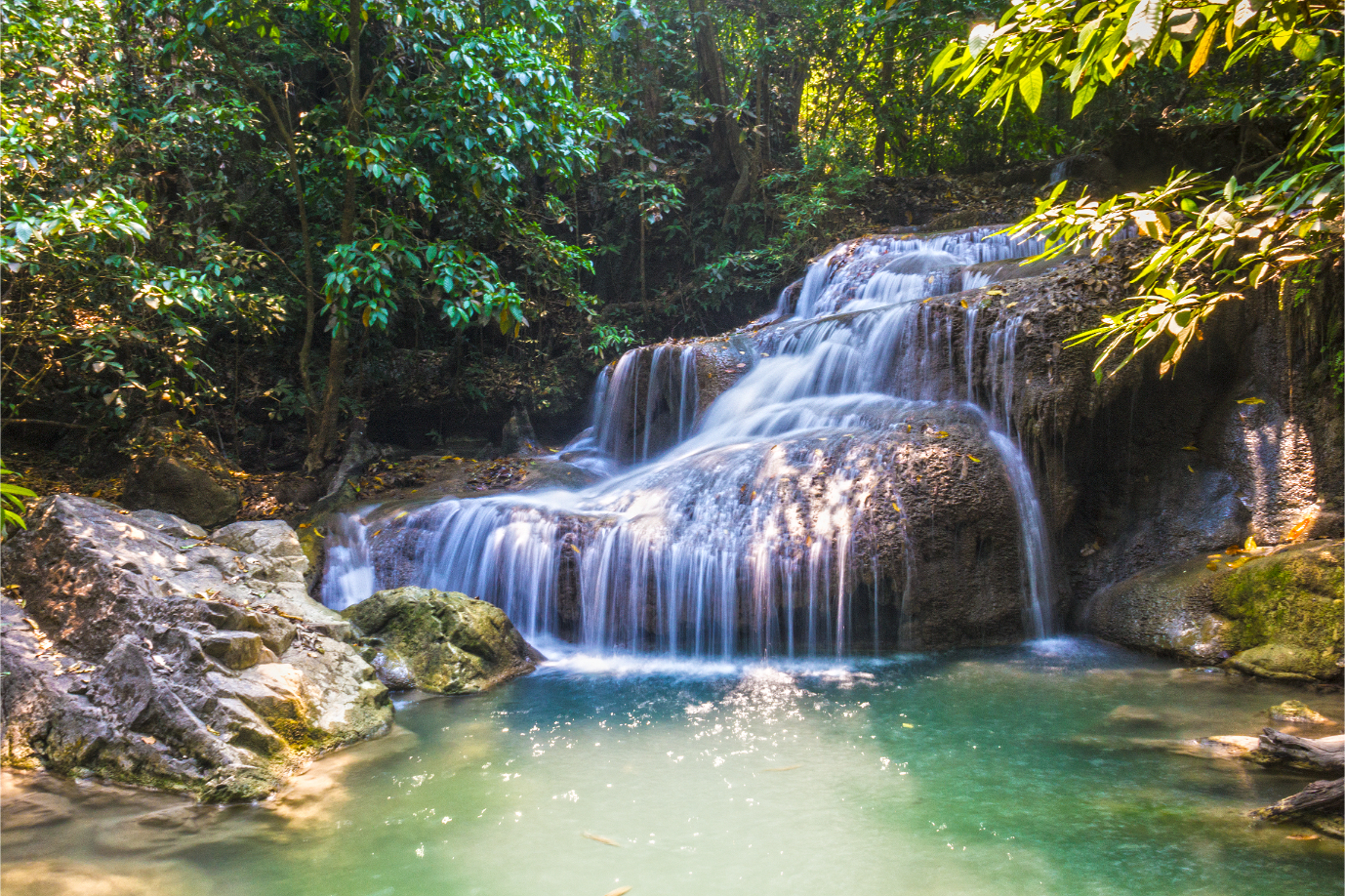
The lowest tier of the falls lived up to the supposedly photoshopped images I had seen. Under a canopy of rattan, makha, bamboo and woody vines, the water dashed into limpid pools. As the sunlight flitted through the foliage, the stream segued between emerald, cerulean and a host of other hues. In the clear waters, I could see abundant fish, which unsuccessfully tried to take cover from the splashing children. I stood transfixed, but eventually had to leave as I wanted to visit the six other levels, of which the last was a 2-km trek from the entrance.
The second level shelters a little cavern under the waterfall, while at the third, water falls from quite a height. After this, the path becomes steeper. The fourth has smooth rocks that people use as water slides. I had planned to take a dip in the highest level, but by the time I reached the fifth, I was soaked in sweat. I dangled my feet in the stream, but immediately recoiled – tiny fish begin nibbling at your skin! While I had experienced fish spas in waterfalls before, the scale of the assault was unprecedented. It took an hour to acclimatise myself to the ticklish sensation and get over the fear (induced by irresponsible travel bloggers) of the foot-long fishes tearing chunks off my body. Once I began swimming, however, the critters moved away and I could finally bask in the surprisingly cool waters. Afloat on my back, I enjoyed the patterns the forest canopy drew against the cloud-studded sky.
While Erawan is famous as a seven-tiered waterfall, there are countless cascades along the stream, each forming cosy pools. As in most of Thailand, references to Indian mythology are never far away. The highest tier of the waterfall, with its three cascades on bulbous rocks, is said to bear a resemblance to Erawan (Airavata in Sanskrit), the three-headed elephant who was the mount of Indra and has several shrines dedicated to him across the country.
During my visit, the park was fairly packed – even though I was visiting on a weekday in the low season. However, the crowds are rarely overwhelming as the trail is wide enough and there are quiet niches all along. Besides, few of the day trippers make it to the higher levels. Regardless, for such a treaded destination, Erawan is remarkably clean – I could not spot a single piece of plastic along the trail or the stream. It helps that picnicking isn’t allowed beyond the second level and there are plenty of park rangers who keep things orderly.
As the sun drooped towards the horizon, I rushed out to make it to the seventh tier before closing hours. The path from the fifth level onwards was slightly trickier. I occasionally had to clamber over rocks or negotiate precarious wooden ladders. After another dip at the highest level, I retraced my steps to explore the ‘nature interpretation’ trails I had seen on the map at the entrance.
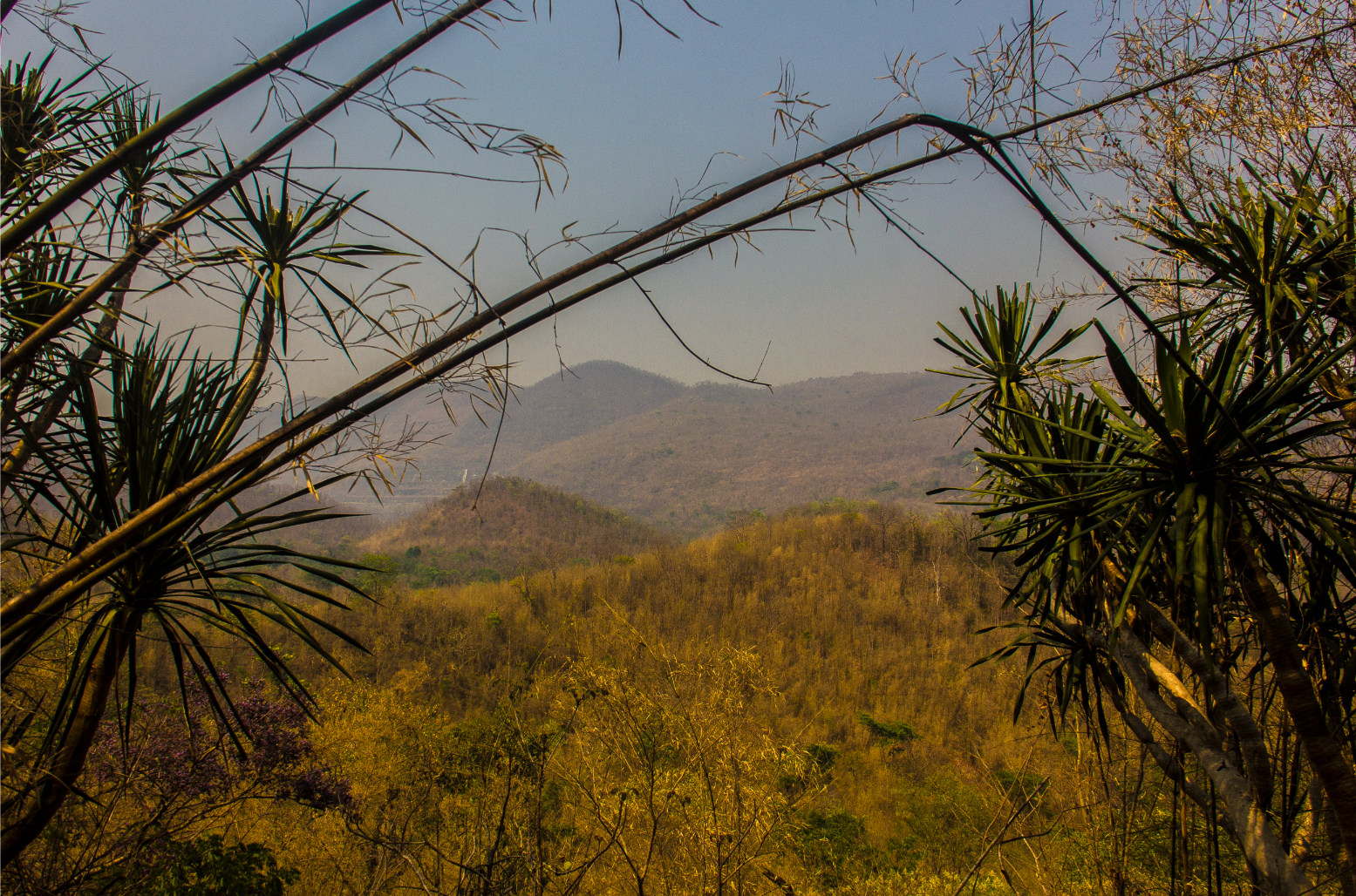
One ran along the stream, while another cut through thick bamboo groves. The former ended soon after it began and the latter was largely unremarkable, until I came to a fork in the road, which, interestingly, did not figure on the map. I did what would have made Robert Frost proud and after an hour of walking alone, reached the summit of a hill. Through the gaps in the thick vegetation, I could see the surrounding mountains, all crackling golden in the parched weather. I had no idea where I was, but was glad to preside over this little piece of paradise.

View of the Erawan National Park from a hiking trail. Photo by Syed Saad Ahmed
I was so engrossed in the view that I didn’t realise I had missed the last bus back to Kanchanaburi. I darted back to book accommodation in the reserve before the visitor centre closed down. I wasn’t expecting much, but as I crossed the rickety rope bridge to the campsite, I was astounded. It was a grassy expanse fringed by tall trees and the Khwae Yai river, over which loomed hills. And the best part – you could pitch your tent right next to the stream! The crowds also disappeared – just four other people stayed at the camp that night.
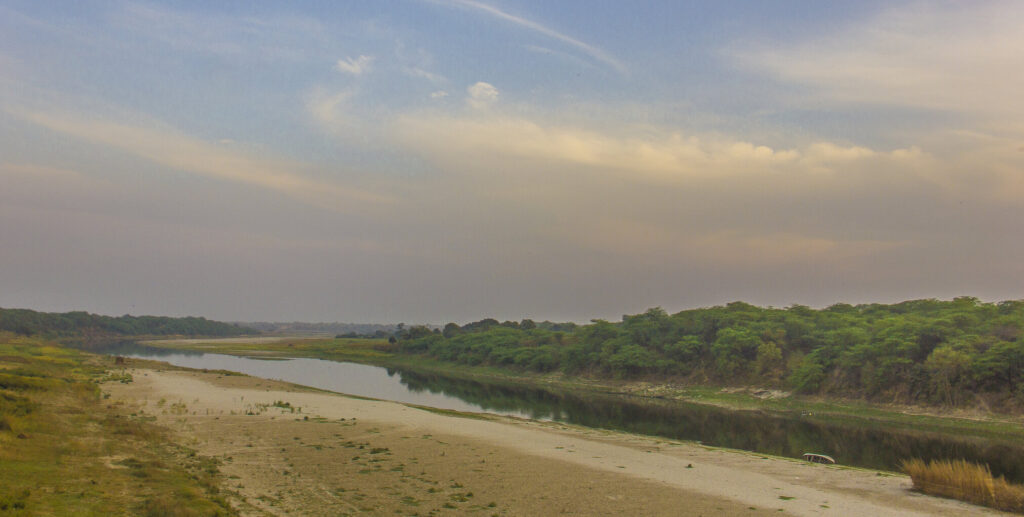
The next morning, I was woken up by the sunlight filtering through the tent. It was remarkably cold – more so since it was peak summer. I stepped out to see the sun edging out from a mountain peak, its shimmering rays rippling in the water. A thick mist smoldered over the river and the trees were aflutter with birdsong. Ensconced by the bank, I relished the most beautiful sight of my fortnight-long trip in Thailand.

Sunrise over the Khwai Yae river. Photo by Syed Saad Ahmed
Thainess, Your Highness: Decoding Thai Culture at Museum Siam, Bangkok
Museum Siam in Bangkok offers a quirky, playful introduction to Thai culture.Continue reading→


Leave a Reply