
An edited version of this article featured in Silverscreen India.
In 2007, Delhi Police published ‘security tips‘ for people from Northeast India residing in the city.
‘When in rooms, do as Roman does (sic),’ it declared. Its supposedly well-meaning advice about ‘revealing dresses’ and visiting ‘decent places’ even singled out food: ‘bamboo shoot, axone and other smelly dishes should be prepared without creating ruckus in neighbourhood’.
In the film Axone, streaming on Netflix, the pungent ingredient made by fermenting soybeans creates more than just a ruckus.
Set in Delhi’s Humayunpur, where tenants from the Northeast live cheek by jowl with mostly Jat landlords, a group of friends make arrangements for Minam’s (Asenla Jamir) impromptu wedding. They want to surprise her with pork and axone. The only hitch? It smells so strong that they try to pass it off as the odour of a septic tank being repaired. Their landlady (Dolly Ahluwalia) catches them smelly-handed despite her grandson Shiv’s (Rohan Joshi) machinations, forcing them to look for an alternative place to cook.
As they go about preparing the feast, they face prejudice, taunts, harassment and even violence—all because they look different from the north Indians around them.
The story also draws on real-life incidents, such as the racially charged murder of a 20-year-old student from Arunachal Pradesh in Delhi in 2014. Axone, however, is far from grim. Its comedic touches evoke the whole spectrum of hilarity—from wry chuckles to uproarious laughter.
While the quest for axone pork, shot almost like a thriller, propels the plot, there are intricate stories woven around the many characters.
Chanbi (Lin Laishram) is angry at her boyfriend Bendang (Lanuakum Ao) for not standing up for her when a man sexually harasses and slaps her on the street. The inexplicably tortured Bendang breaks down when he is unable to strum and sing Uthe Sabke Kadam. Zorem (Tenzin Dalha) is initially cagey about helping Minam. Upasana (Sayani Gupta) wants to marry and get ‘settled’, as opposed to the ‘career-oriented’ Chanbi. These seemingly random plot points come together in unexpected ways towards the end of the film, which makes the narrative even more engaging.
Considering that the story unfolds over a single day, it must have been a task to ensure visual continuity in a crowded, cramped place like Humayunpur.
But cinematographer Parasher Baruah has strikingly rendered the locality’s warren-like lanes and poky houses in a widescreen format.
It would have been easy to let the film derive flavour from a marinade of stereotypes, which it partially does.
The north Indian characters are not as fleshed out as those from the Northeast and it often relies on tired tropes, such as the horny Delhi boy. But director and writer Nicholas Kharkongor also subvert these pigeonholes.
They are many layers to the characters’ personalities, which unfold as the film progresses. Even among the outsiders, there is an outlier—the Nepali Upasana, who, as Shiv declares, is not ‘fully Northeastern’. There are plenty of racists in the neighbourhood, but there are also nice, helpful people. And often, both turn out to be the same.
Axone has more diversity in one frame than many Indian films have in their entire runtime.
In the apartment where the protagonists live, the other tenants are Africans and a presumably single Bengali mother and her daughter. The protagonists seek help from Martha, who has married a Sikh man from the neighbourhood and has a multiethnic son. In an industry that reduces entire communities to stock characters, their inclusion without the accompanying clichés is refreshing.
One thing, however, stands out: the film seemingly hundreds of languages, tribes, geographies and cuisines into a single identity—’Northeastern’—that has more to do with the dimensions of one’s eyes than culture.
The film doesn’t tell us that axone is a Naga ingredient. The ethnic origins of most characters are rarely apparent, though one guesses Zorem is Mizo because he has a casserole with ‘Made in Mizoram’ etched on it. Some might see this as Axone portraying ‘Northeastern’ people through the homogenising lens of their racist neighbours. But considering how the film seamlessly incorporates diverse languages (around 15, according to the director), songs, and cultural references, it comes across more as an unapologetic assertion of identity. ‘This is who we are and how we live. If you don’t know what axone is, that is your ignorance. Our culture needs no footnotes,’ it seems to say.
In this respect, the movie is an unprecedented achievement. But as the first ‘mainstream Hindi’ film (it is produced by Yoodlee Films, a division of the entertainment behemoth Saregama) about people from the Northeast, mostly played by characters from the region, it bears the burden of appropriate representation.
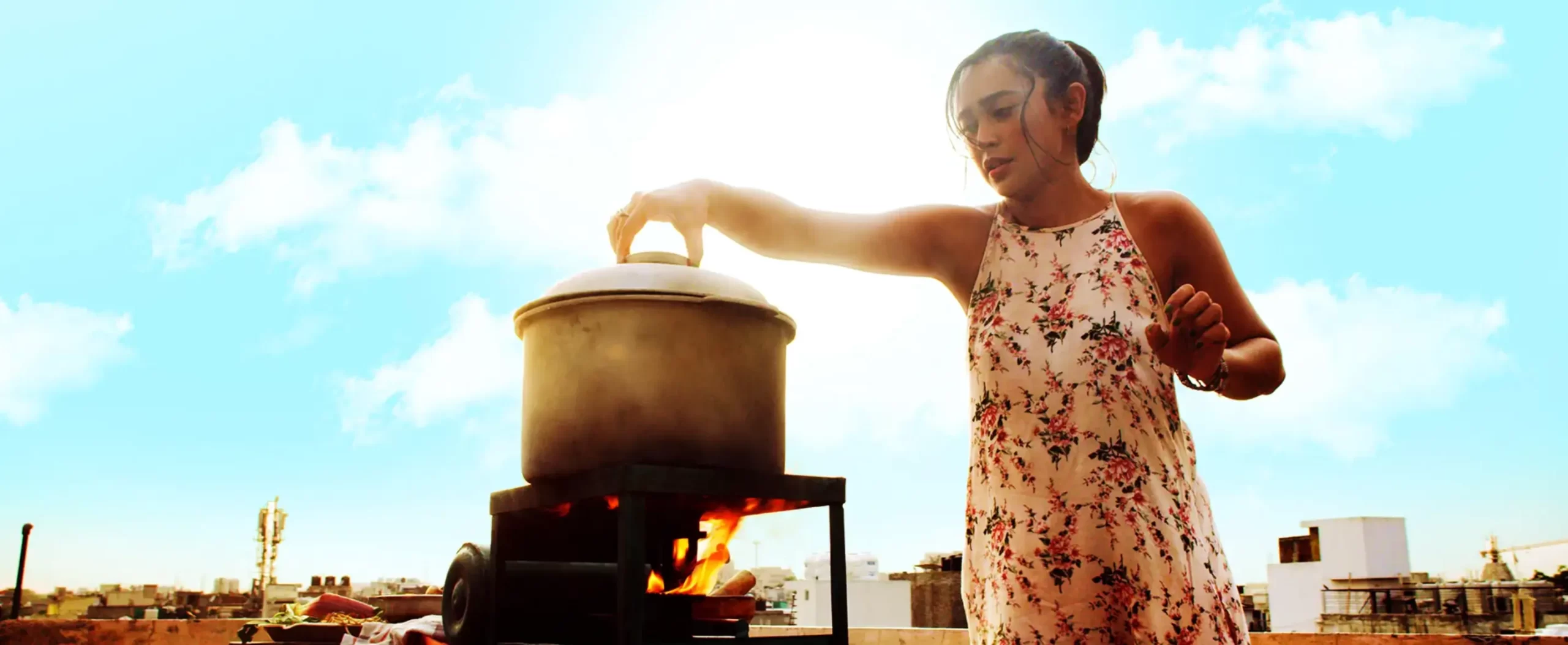
Many, including Nepalis, have lauded Sayani Gupta for getting the accent on point, while others have criticised the casting of a Bengali actor for the role despite her endearing performance. She might have been cast in the film perhaps because she is a known Bollywood face, but one could conjecture that casting her also establishes her character as an outlier within the group.
Tenzin, who plays Zorem, is Tibetan. If it is acceptable for him to essay a Mizo shopkeeper, should it not be so for a Bengali actor playing a Nepali character? If one thinks Tenzin is apt for the role because of how he looks, is one not responsible for the same elision of identities that the film’s racist characters do?
Axone also echoes the debates on cultural clashes and integration happening around the world.
These sometimes put the onus on the oppressed rather than the oppressor. For instance, Chanbi reprimands Bendang for not ‘making a single friend from here’. Martha responds to Chanbi’s, ‘We have the right to cook our food’ with ‘And they have a right to not suffer the smell of our food. Is their right right or is your right right?’ Are they being apologists for prejudice or do they have a point?
The film intrigues with the problems it poses, but does not give definitive answers—viewers have to tease these out for themselves.
And with its hearty humour, poignant moments, and multiplicity of perspectives that shun what Chimamanda Ngozi Adichie calls “the danger of a single story”, it is a rewarding task indeed.
In Axone, we realise what Indian cinema has lost by ignoring the stories of Chanbi and Bendang, and talented actors like Lin Laishram and Merenla Imsong. Hopefully, it will open the ventilation hatch to films about tungtap, rawtuai bai and yongchak singju. And instead of complaining, people might relish these. Perhaps, that is already happening to some extent. Racism remains a problem across the country, but Humayunpur today has more restaurants from the Northeast than from any other part of India, packed with as many people from outside the region as within. And that ‘smelly’ axone? Nothing tastes better than a hunk of meat oozing its pungent goodness and the fiery bite of king chilli.