
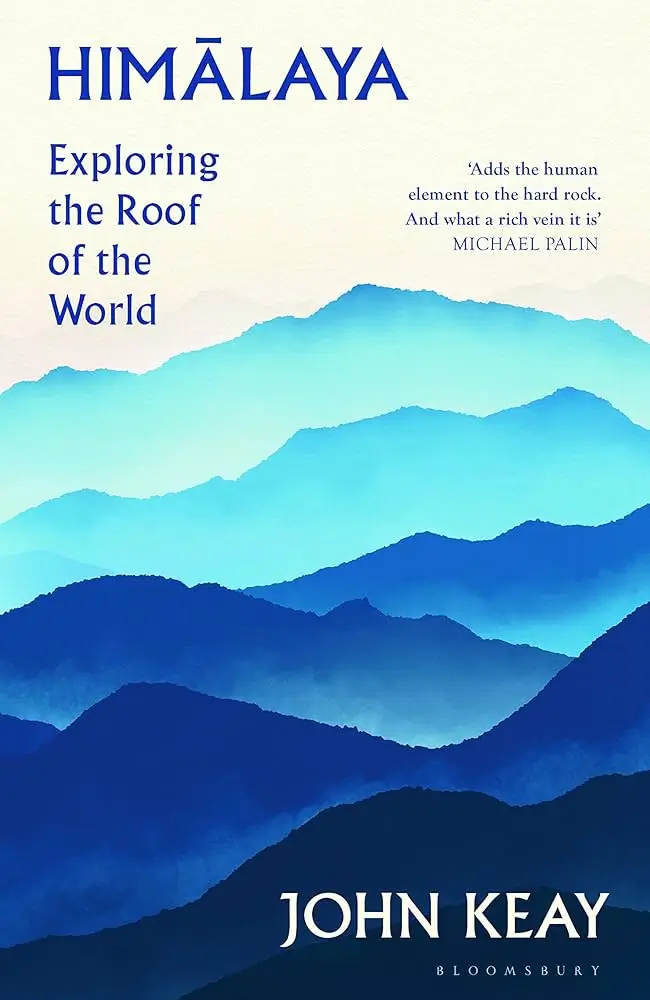
An edited version of this article was published in Hindustan Times
John Keay, a correspondent in Kashmir in the 1960s, has written extensively on the Himalaya and exploration. His book The Great Arc: The Dramatic Tale of How India was Mapped and Everest was Named is an illuminating account of the longest measurement ever of the earth’s surface that stretched 1,600 miles and took over 40 years to complete. Considering his prolific oeuvre, I was curious about what more he had to say about the world’s highest mountain range in his latest book, Himalaya: Exploring the Roof of the World.
But the work is hard to pin down. It is neither history nor biography, though it incorporates elements of both. It begins with the British expedition to Tibet that culminated in 1904, followed by two chapters on how the Himalaya came to be, and another on the fossils it harbours. Next is an investigation into the ancestry of Tibetans. I was not sure where the author was leading to, but then chapter after chapter dwelled on the exploits of people trying to “conquer” the mountain range.
In the prologue, Keay hints at the meandering structure: ‘…this book may seem as disjointed as the Himalayan skyline…To provide a thread of continuity, I have instead focused on the human component in Himalayan studies, the personalities and their adventures, and I have sometimes taken liberties with the chronology.’
While the randomness is vexing, I eventually got used to it. The problem, however, is that along with the chronology, he has also taken liberties with the ‘human component’—unless, by humans, he means dead white men (and one woman). The author’s focus is so disproportionately on European explorers that Himalaya’s habitants seem incidental to the narrative. Keay’s account treats them as objects rather than subjects, let alone as communities with rich cultures and lives. Tibetans, for instance, come across as people to be killed or hired as guides, when they are not shrouded in ‘mystery’, that is.
Keay frequently quotes Orientalist excerpts from writings by colonial explorers, accepting them at face value without a trace of scholarly interrogation. Once or twice, he does call out imperialist conceit, but for the most part, it seems as if he has internalised their biases in his writing. His perspective is evident in his frequent use of words like ‘virgin’, ‘exotic’, ‘savage’, and ‘esoteric’. The book blurb terms the mountain range ‘confounding’. While I can understand why European authors writing a century or two ago would employ these descriptors, Keay using them today is infinitely more confounding than he makes the Himalaya to be.
It gets worse though. In the chapter Gold Dust and Yak Tails, he writes: ‘…infected from within by Nepali migration, Sikkim now exists in little more than name and nostalgic remembrance.’ There are so many ways to formulate this sentence that do not involve comparing a social group to an infection. In the chapter Pilgrims’ Progress, he writes about the ‘ethnic frontier between the trouserless tribals and the better-clad Tibetans’. While this formulation is quintessential of Keay, I wonder how editors and proofreaders let a phrasing like ‘trouserless tribals’ go to print.
Besides, if Keay’s focus was solely on explorers, it is befuddling that he did not bother to delve into the adventures of Indian voyagers, such as Pundit Nain Singh and Kishen Singh, whom he mentions several times in passing. Pundit was the term for Indian surveyors the British trained and employed to furtively map Tibet and other territories beyond the empire’s frontiers. Europeans were not allowed in these regions and the pundits disguised themselves as traders and pilgrims to garner information on the topography, politics, and culture.
While Keay glosses over the pundits, he does dwell at length on some non-Europeans, such as Zorawar Singh, who invaded Tibet, and Kintup, an explorer from Sikkim. Though why he chooses to focus on them and not other equally pivotal figures is anyone’s guess.
One could say that Himalaya’s structural anarchy is the only uniting thread between its wildly diverging narratives. The authorial decisions seem to draw from whimsy rather than logical or structural considerations. Keay skittishly jumps from one subject to another, often multiple times within a chapter. For example, in the chapter Sublime Deliverance, he bounces from Alexandra David-Néel, a ‘one-time opera singer turned Buddhist scholar’, to Colonel Leonard Francis Clark of the US army, Swiss geologist August Gansser, and Naro Bun Chon, a lama (For brevity’s sake, I have only mentioned a few of the many names that randomly pop up in this section). It is a roller coaster of a narrative that left me disoriented. The book does not offer any clues to these seemingly impulsive choices, making it a frustrating read.
Occasionally, Himalaya does get interesting. In the chapter The Karakoram Anomaly, Keay writes about the Hunzakut in the Karakoram mountains differentiating between ‘male’ and ‘female’ glaciers, and how they use the ‘artificial insemination’ of ‘amorous glaciers’ to fulfill their water needs. But for the most part, it seems as if the author does not know how to extricate the grain from the chaff, leaving the reader bumbling through a bog of information.
Even where Keay manages to be coherent, his dry writing left me parched. Even as a treatise on the adventures of colonial explorers, it fails. Himalaya reads as a catalogue of events, without a smidgen of storytelling. The excitement and passion that writers like Robert Macfarlane and Bill Bryson bring to nature or historical writing are sorely missing. This is most evident when Keay quotes other authors. The liveliness of those excerpts shines in stark contrast to his plodding prose.
Himalaya begins with the line, ‘History has not been kind to Himalaya’. Unfortunately, neither has Keay in his book. At its best, it has interesting trivia every 50 pages or so. At its worst, it serves as a guide on how not to write a book.


Leave a Reply