
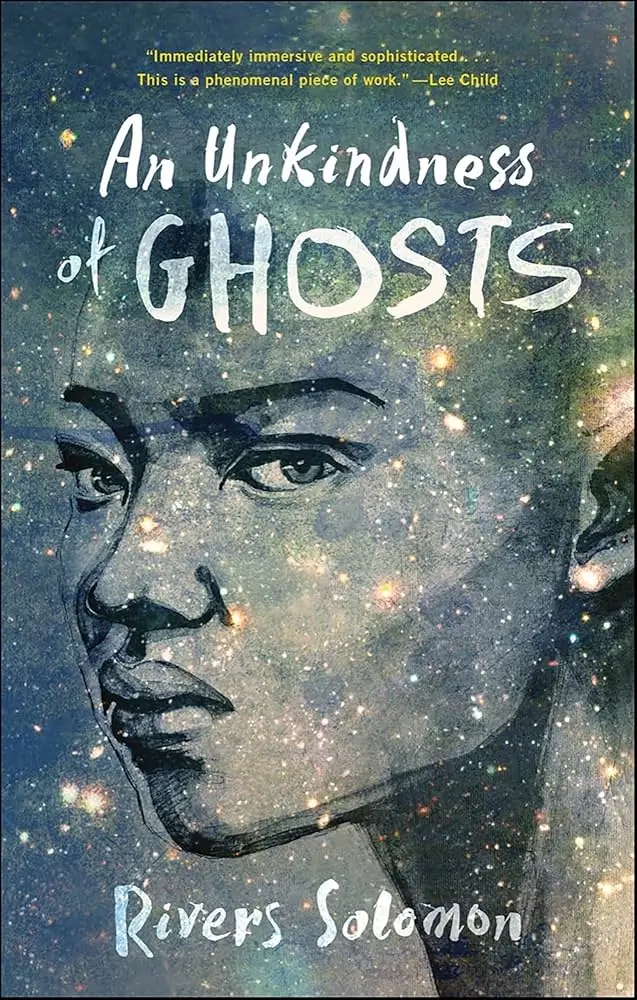
An edited version of this review was published in Hindustan Times
Super, a 2010 Kannada film, imagines a strange but apt utopia. In its make-believe world, India has become a superpower in 2030. Indians are prosperous and have “White servants”, while the latter do all the menial jobs and beg on the streets. Its imagination is so limited that it cannot even imagine a utopia without poverty and discrimination. Today, as blundering billionaires seek to establish utopias on Mars, one can only wonder what dystopia it would entail for the rest of us.
Rivers Solomon imagines one such world built on the back of a dystopia in An Unkindness of Ghosts. In the novel, humanity — or what is left of it — has been hurtling through space in the ship Matilda for over 300 years. They had to leave their former abode, the Great Lifehouse, after an unexplained catastrophe, but their purported destination, the Promised Land, seems increasingly elusive.
Matilda holds tens of thousands of people organised in alphabetical decks. The lighter-skinned live in the upper decks, where they luxuriate in wildlife sanctuaries, lakes, beaches, and sports fields. The darker-skinned underclass in the lower decks have to bear constant abuse, violence, and surveillance by guards. There are nightly headcounts, missing which leads to dire punishments.
The protagonist, Aster, is a resident of Q deck and thus, low in the pecking order. Her mother, Lune, mysteriously disappeared when she was young. The journals, notes, and sketches she left behind seem like “eccentric ramblings” to Aster, who suspects she might have had early-onset dementia. Her friend and bunkmate, Giselle, however, has a different explanation.
Aster assists Theo, the ship’s Surgeon General, who has trained her in medicine. For many in the lower decks, Aster’s is the only medical care they can access. Her services include abortions for those in the lower decks who become pregnant after rapes by upper-deck men. She also has a secret garden and laboratory, where she cultivates plants and synthesises medicines.
The worldbuilding in the novel focuses more on social relations rather than technological advancements. Solomon’s stratified society has many analogues with slavery in the United States. There are occasional forays into scientific curiosities and unfamiliar technologies, but the author glosses over them quickly. There are no elaborate explanations for how a spaceship with tens of thousands of people has functioned for centuries, why life on the Great Lifehouse collapsed, or where exactly they are headed. It seems as ad hoc as our era’s billionaire space race and dreams of colonising Mars.
Instead, cruelty and oppression — and the resistance against it, the compassion despite it — animate Matilda’s make-believe world. By focusing on the misfits in it, Solomon further lays bare its stratified and regimented nature that everyone is subject to.
Aster takes things too literally and consequently, has trouble understanding what people want to say. She is also queer: “a boy and a girl and a witch all wrapped into one very strange, flimsy, indecisive body”.
Her friends, Theo and Giselle, also do not conform to the ship’s strict codes. Aster describes Theo as an “otherling” and “gender malcontent”. He is part of the upper decks and close to the Sovereign (“the Heavens’ chosen ruler”) despite his questionable background. However, his sympathies lie with Aster and her ilk. The powerful in Matilda use religion to justify the worst abuses, but Theo is deeply religious and we often find him praying.
Giselle frequently disappears and breaks the rules, suffering brutal punishments. She is unable to come to terms with the world around her and becomes increasingly disturbed. It is these characters and their interpersonal relationships that make the novel compelling.
Solomon plunges the reader into this unfamiliar world; there is little by way of explanation. As a result, I felt adrift in the beginning. However, I was soon immersed in the joy of discovery. The reader gradually learns about Matilda as the novel’s protagonists uncover its secrets.
We see the characters at a time when blackouts have become common on the ship, leaving lower-deck residents to contend with frigid temperatures. Some even suffer from frostbite-induced gangrene, requiring amputations. Lune used to work as a mechanic on the ‘miniature star’ that provided power to Matilda. Aster feels that the blackouts’ timing aligns too neatly with a mysterious illness for it to be a mere coincidence.
Towards the end though, the narrative changes its cadence. Many momentous things happen in quick succession and the intricate plotting gives way to abrupt resolutions. It also relies on the trope of a heroic individual almost single-handedly changing things. As a result, the ending feels a bit contrived, though satisfying nonetheless. It is heartening to see a character one has been rooting for realise the unimaginable in a world skewed against her.
I have rarely encountered characters like Aster in fiction. Her neurodivergence is not a plot point, but an intrinsic part of who she is. In fact, the novel does not even use the term to describe her — rather, the author makes it evident from plentiful clues tossed into the narrative. We see the world through Aster’s lens and as Solomon puts it, she sees the world “sideways”.
However, not all characters are as deftly delineated. The new Sovereign’s hate for Aster seems irrational at times. There are clues though: the Sovereign, obsessed with Theo, is jealous of the close relationship he shares with Aster. He also cannot stand her defiance. While these do not seem motivation enough for someone as powerful as him, one could argue that there are multiple real-life instances of autocrats obsessing over trifling matters.
Today, across countries, despots are making arbitrary decisions with far-reaching ramifications for people who have no stake in them. An Unkindness of Ghosts shows how resistance against their unbridled power can take many forms — sometimes bloody, sometimes with heartbreaking consequences, but also, often joyful.

Leave a Reply