
Tag: The Tribune

  • “I Wasn’t Getting Work as an Actor. I Made a Film so I Could Act”: Sunder Pal, Director, Vilom

    “I Wasn’t Getting Work as an Actor. I Made a Film so I Could Act”: Sunder Pal, Director, Vilom

    An edited version of this piece was published in The Tribune

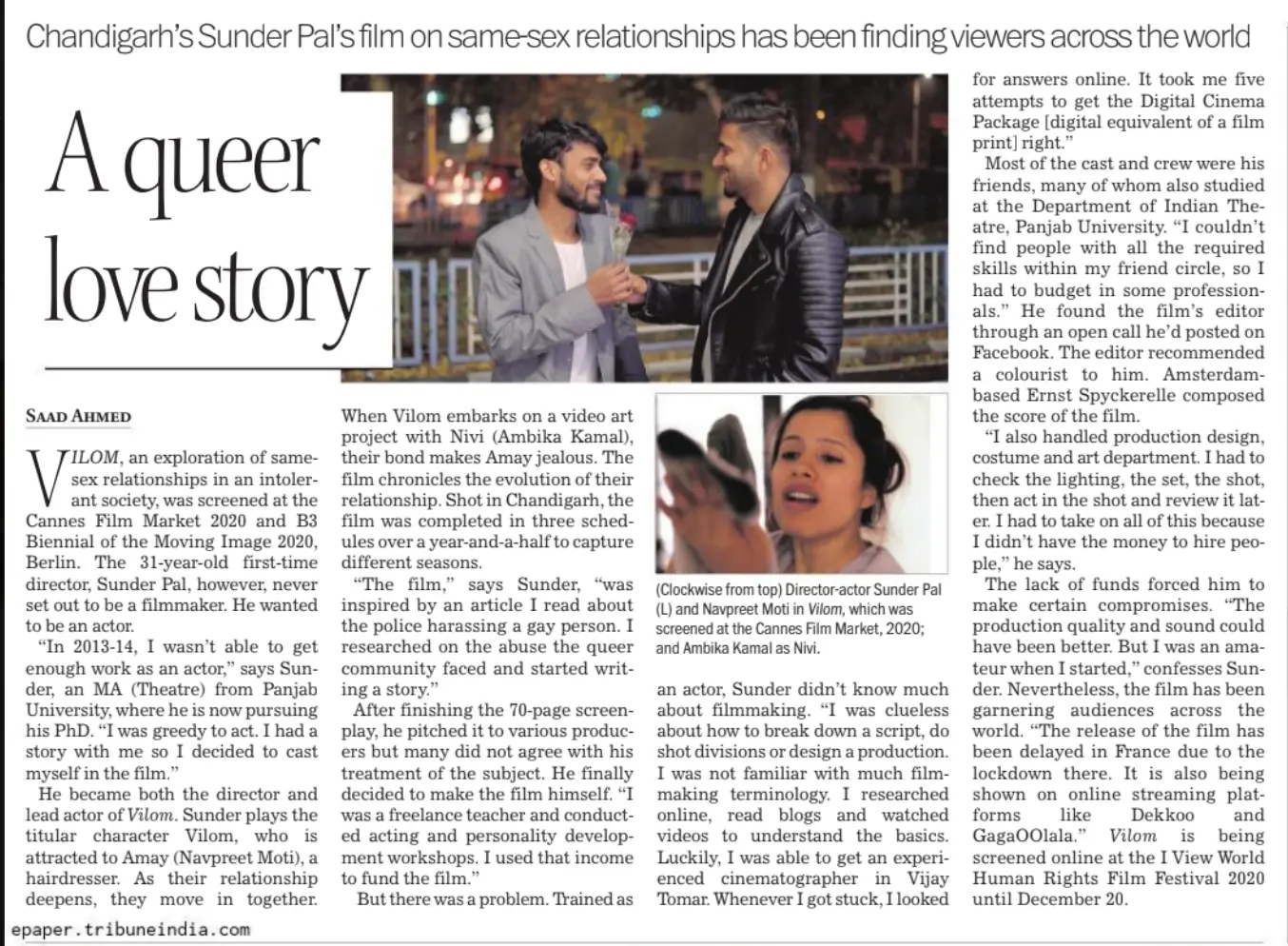
    Sunder Pal’s film Vilom, an exploration of same-sex relationships in an intolerant society, was screened at the Cannes Film Market 2020 and B3 Biennial of the Moving Image 2020, Berlin. The 31-year-old first-time director, however, never set out to be a filmmaker – he wanted to be an actor. 

    “In 2013-14, I wasn’t able to get enough work as an actor,” says Sunder, an MA in Theatre from Panjab University, where he is now pursuing a PhD. “I had an idea for a film and wanted to make it so that I could act — I was greedy to act. And since people weren’t casting me, I decided to cast myself in my film.”

    That’s how he became both the director and lead actor of Vilom. Sunder plays the titular character Vilom, who is attracted to Amay (Navpreet Moti), a hairdresser. As their relationship deepens, they move in together. When Vilom embarks on a video art project with Nivi (Ambika Kamal), their bond makes Amay jealous. Meanwhile, Amay’s mother keeps cajoling him to marry. The film chronicles the evolution of their relationship in response to these and other challenges. Shot in Chandigarh and its environs, Vilom was completed in three schedules over a year-and-a-half to capture different seasons. 

    “The film,” says Sunder, “was inspired by an article I read when I was in Chandigarh. It was about the police harassing a gay man. I began researching about other such cases and the abuse the queer community faces and started writing a story. Initially, making a film wasn’t on my mind, but as I wrote, it motivated me to make a film.” 

    After finishing a 70-page screenplay, he pitched it to various producers. “Some people were interested, but they did not agree to the treatment I wanted. So, I finally decided to make the film myself,” he says. “I was a freelance teacher and conducted acting and personality development workshops. I used that income to fund the film.”

    But there was a problem — trained as an actor, Sunder didn’t know much about filmmaking. “I was clueless about how to break down a script, do shot divisions or design a production. I didn’t know certain filmmaking terminology. But I researched online, read blogs and watched videos to learn the basics. I still don’t know much about lenses, but luckily, I had an experienced cinematographer [Vijay Tomar]. Whenever I got stuck, I looked for answers online. It took me five attempts to get the Digital Cinema Package [digital equivalent of a film print] right.”

    Most of the cast and crew were his friends, many of whom also studied at the theatre department of Panjab University. “As my resources were limited, they worked for free, but I told them I would pay them once the film made money. I couldn’t find people with all the required skills within my friend circle, so I had to budget for some professionals. Otherwise, the film would have been ruined.” He found the film’s editor through an open call he had posted on Facebook. The editor recommended a colourist to him. Amsterdam-based Ernst Spyckerelle composed the score of the film.  

    The crew, however, was quite small and Sunder had to take on a lot of responsibilities. “Apart from acting and directing, I had to handle the production design, costume and art department. I had to check the lighting, the set, the shot, then act in the shot and review it later. I had to take on all of this because I didn’t have the money to hire people,” he says. 

    The lack of funds forced him to make certain compromises. “I wanted to use a particular lens, but couldn’t afford it. The production quality could have been better. The sound is okay, but I’m not happy with it. Besides, I was quite amateur when I started,” confesses Sunder. Regardless, Vilom is garnering an audience across the world. “The film has got distribution deals,” he says. “It was supposed to release in France, though that has been delayed due to the lockdown there. It is also available on Dekkoo and GagaOOlala (online streaming platforms).”

    Vilom is being screened online at the I View World Human Rights Film Festival 2020 until December 20
    Print Version of the Article

  • She Came, She Gamed, She Conquered: Interview With Game Designer Poornima Seetharaman

    She Came, She Gamed, She Conquered: Interview With Game Designer Poornima Seetharaman

    An edited version of this interview was published in The Tribune

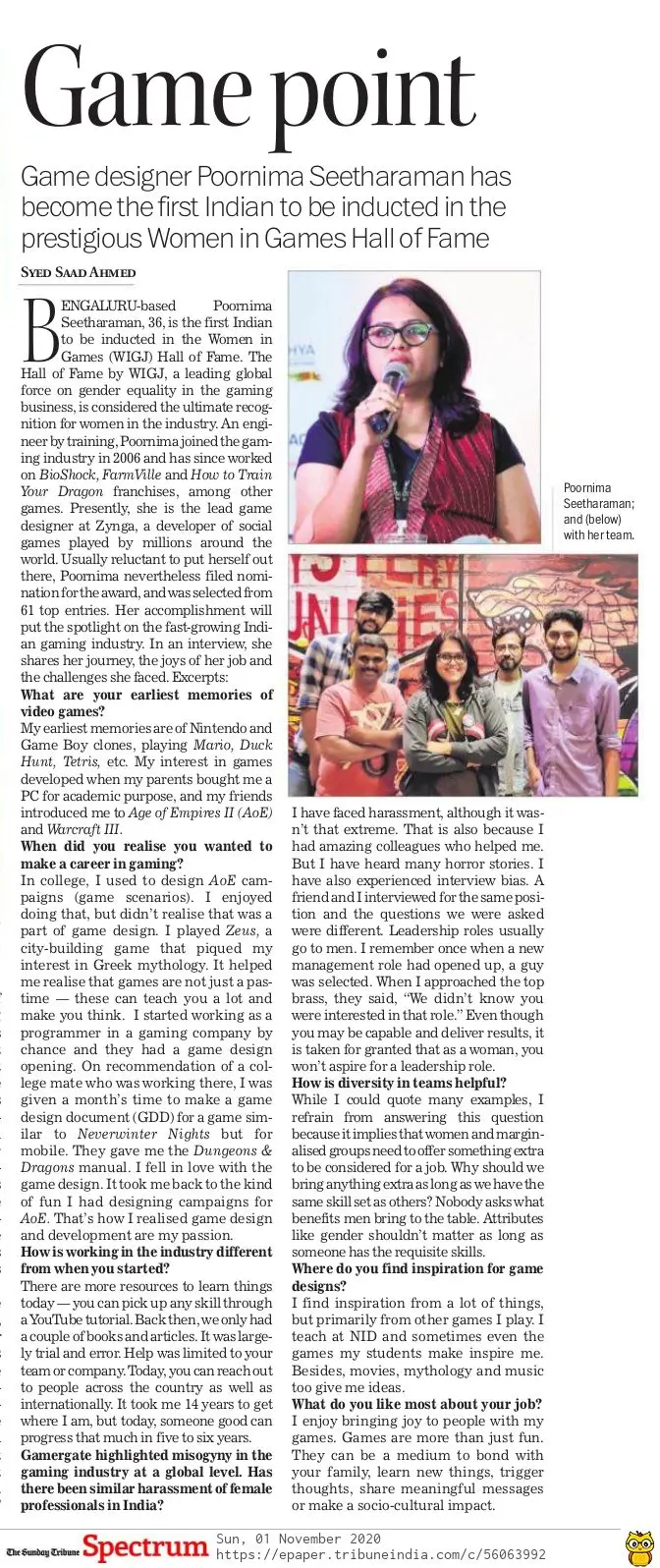
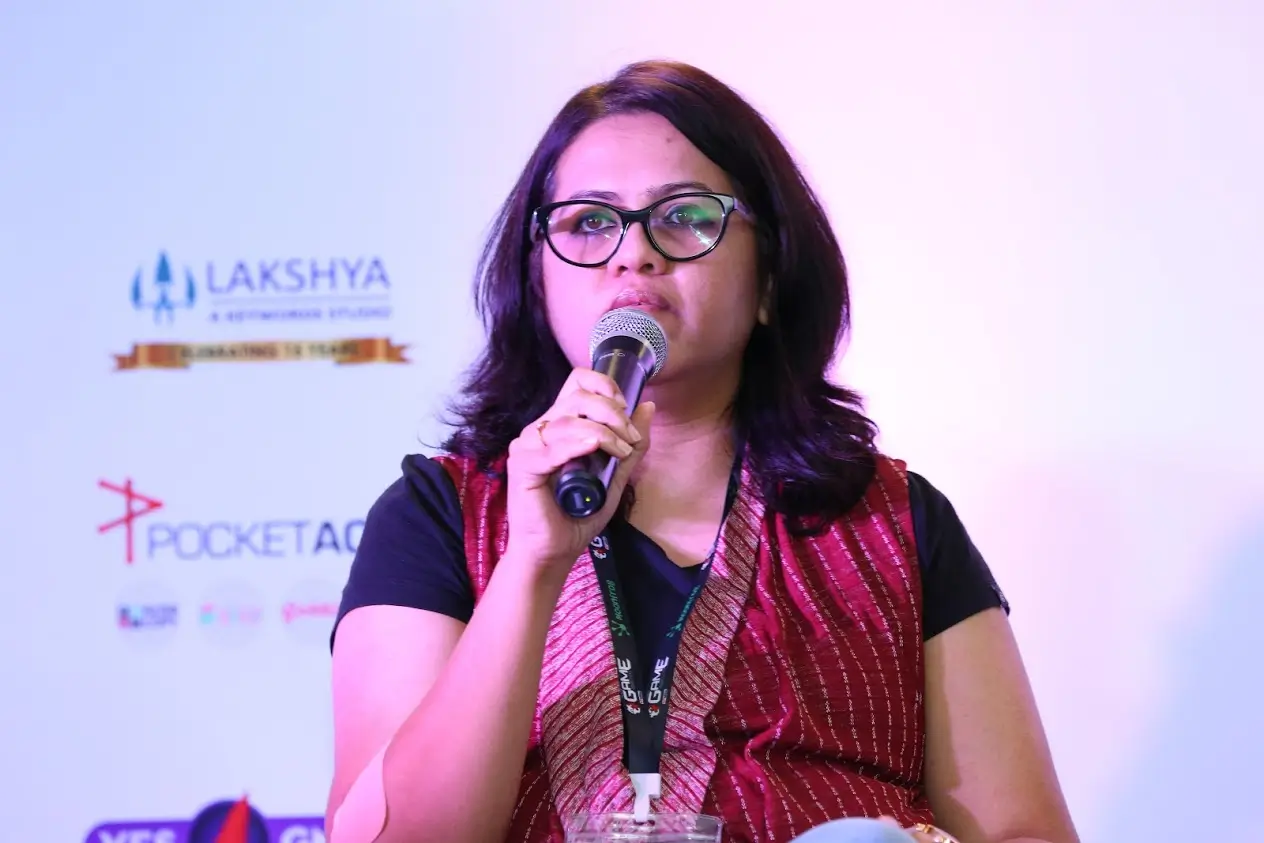
    Bangalore-based Poornima Seetharaman, 36, is the first Indian to be inducted in the Women in Games (WIGJ) Hall of Fame. WIGJ is a not-for-profit organisation promoting a games industry, culture and community free of gender discrimination. The Hall of Fame is considered the ultimate recognition for women in the industry.

    An engineer by training, Poornima joined the gaming industry in 2006 and has since worked on BioShock, FarmVille and How to Train Your Dragon franchises, among other games. She is now the lead game designer at Zynga, a leading developer of social games played by millions around the world.

    Usually reluctant to put herself out there, Poornima nevertheless filed her nomination for the award and was selected among 61 entries. Her accomplishment is likely to put the spotlight on the fast-growing Indian gaming industry. In a conversation over the phone, she shares her journey, the joys of her job and the challenges she faced.

    What are your earliest memories of video games?

    My earliest memories are of Nintendo and Game Boy clones, playing Mario, Duck Hunt and Tetris. My interest in games developed when my parents bought me a PC for academic reasons and my friends introduced me to Age of Empires II and Warcraft III.

    You joined the gaming industry by chance. When did you realise you wanted to make a career in it?

    In college, I used to design Age of Empires campaigns (game scenarios). I enjoyed doing that, but didn’t realise that was a part of game design. I played Zeus, a city-building game that piqued my interest in Greek mythology. It helped me realise that games are not just a pastime—they can teach you things and make you think.

    I started working as a programmer in a gaming company by chance and they had a game design opening. One of my college mates was also working there. He referred me for that role. They gave me one month to make a game design document for a game similar to Neverwinter Nights, but for mobile. They gave me the Dungeons & Dragons manual. I remember going through it and falling in love with game design. It took me back to the kind of fun I had designing campaigns for Age of Empires. That’s how I realised game design and development are my passions.

    How is working in the industry different now compared to when you started?

    It’s much easier to grow now than before. There are more resources to learn things—you can pick up any skill through a YouTube tutorial. Back then, we only had a couple of books and articles. It was largely trial and error. Help was limited to your team or your company. Today, you can reach out to people across the country as well as internationally. It took me 14 years to get where I am, but today, someone good can progress that much in 5-6 years.

    Where do you generally find inspiration for your game designs?

    I find inspiration from a lot of things, but primarily from other games—I play a lot of games. I teach at the National Institute of Design and sometimes even the games that my students make inspire me. Apart from that, movies, mythology and music give me ideas.

    What do you like most about your job?

    I enjoy bringing joy to people with my games. Games are more than just fun. They could be a medium to bond with your family, learn new things, trigger thoughts, share meaningful messages or make a socio-cultural impact. It’s lovely to be able to do all these with games.

    Gamergate (an online harassment and backlash campaign targeting women in the video game industry) highlighted the misogyny in the gaming industry at a global level. Has there been similar harassment of female professionals in India?

    I have faced harassment, although it wasn’t that extreme. That is also because I had amazing colleagues who helped me. But I have heard many horror stories. I have also experienced interview bias. A friend and I interviewed for the same position and the questions we were asked were quite different. Besides, leadership roles usually go to men. I remember once when a new management role had opened up, a guy was selected. When I approached the top brass, they said, “We didn’t know you were interested in that role.” Even though you may be capable and deliver results, it is taken for granted that as a woman, you won’t aspire for a leadership role.

    How is diversity in teams helpful?

    While I could quote many examples, I refrain from answering this question because it implies that women and marginalised groups need to offer something extra to be considered for a job. Why should we bring anything extra as long as we have the same skill set as others? Nobody asks what benefits men bring to the table. Attributes like gender shouldn’t matter as long as someone has the requisite skills.

    Print Version of the Article

    A screenshot of the article above. The header is "Game Point".
  • Insect Watching as a Hobby? People Are Making a Beeline for it

    Insect Watching as a Hobby? People Are Making a Beeline for it

    An edited version this article was published in The Tribune

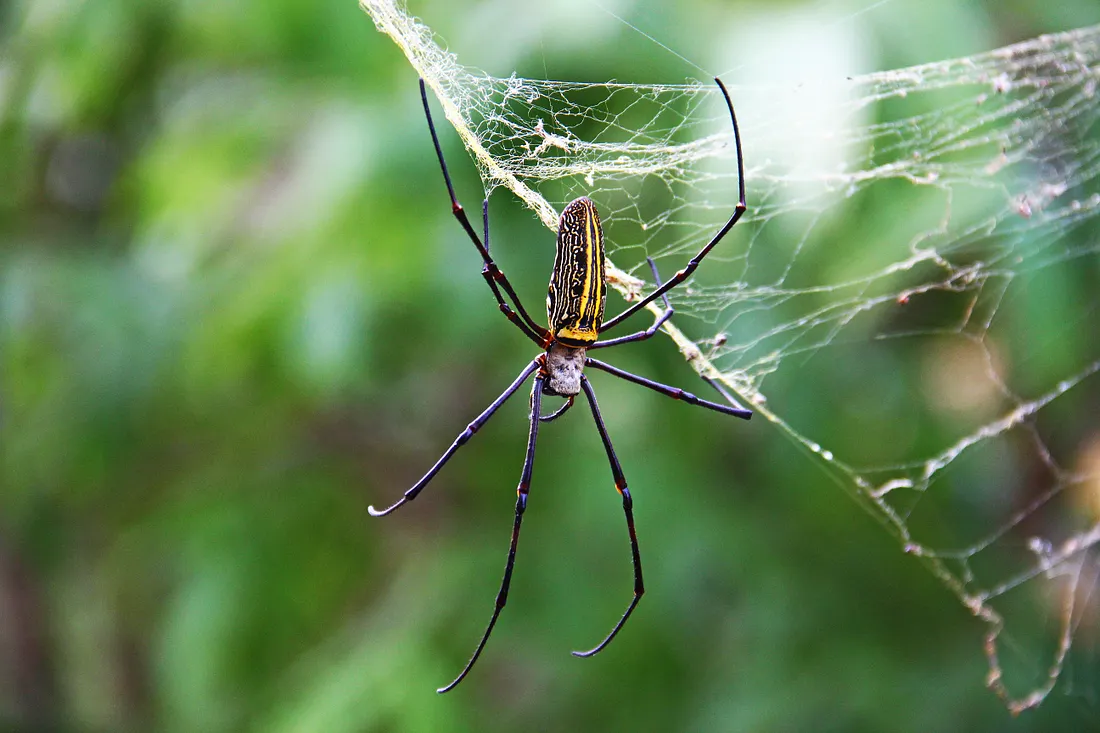
    Atul often gets strange looks from strangers. Whether it is while photographing a crevice in a wall or crouched on a pavement, people come up to him to ask what he’s doing or stare in puzzlement. But unbeknown to them, the 25-year-old engineer and nature enthusiast is engrossed in the fascinating realm of bugs.

    While mosquitos and cockroaches are unlikely to evoke much fascination, there are millions of other insects, each with their peculiar appearance and habits, that can be exciting to observe. Take some species of assassin bugs, which, as their name suggests, are not to be messed with. They stab and paralyse their prey, suck their liquefied innards and wear their corpses as armour and for camouflage! Figs would disappear without fig wasps — there are about 900 species of figs and each has a dedicated wasp which pollinates it. Crickets are commonplace, but it might come as a surprise that the frequency of their chirping is proportional to the ambient temperature.

    “Insects are more interesting than mammals,” says Sohail Madan, manager of the Conservation Education Centre at the Asola Bhatti Wildlife Sanctuary, New Delhi. “Though tigers and elephants are big and beautiful, their characteristics and habits are somewhat like ours. If you observe bugs closely, you’ll see a whole new world of patterns, colours and textures. They have been on earth for much longer than us and their life history and evolution are unique.” Interestingly, what we commonly call insects encompass a variety of biologically distinct organisms that, strictly speaking, are not insects. Spiders, millipedes and snails for instance.

    The centre organises nature walks in Asola. Over the past year, they have invited visitors to track butterflies, dragonflies, moths and other creatures. “Every September, we celebrate Butterfly Month to publicise urban wildlife, which is largely insects,” mentions Sohail. “Insect watching is becoming quite popular, especially with photographers.”

    The best part is that you don’t need to go to a forest to observe them. “Just a square foot of soil or a single plant can harbour thousands of bugs,” says M. Yuvadeeban, a naturalist and writer based in Chennai. “Giant milkweed, a common plant in even heavily urbanised areas, is home to a diversity of species, such as the painted grasshopper, cotton stainer, carpenter bee, red milkweed bug and plain tiger butterfly.”

    The ideal place to begin is your own backyard, terrace or balcony garden. The undersides of leaves harbour many creatures. If you see chomped foliage or a bare branch, there’s likely to be a bug around. Some creatures, like cicadas and borers, live on tree trunks, while others — woodlice, centipedes and ants — take shelter under rocks. Flowers attract pollinators, such as butterflies, moths and bees. Many bugs reside in soil, while others inhabit leaf litter.

    While Yuvadeeban regularly documents his entomological adventures on Instagram, his first tryst with insect watching was not as pleasant. “I must have been in kindergarten when I saw a stink bug on a soap nut tree. I picked it up to show it to my teacher, but it sprayed acid on me. My cheeks were swollen for a long time. That’s why it’s important to educate yourself before you start.”

    While some insects bite or sting, others spray acids or blistering agents. Skin contact with hairy caterpillars leads to intense itching and rashes. To protect yourself during nature forays, wear neutral hues that blend into foliage, full sleeves, trousers, socks and shoes, and avoid perfumes. You don’t need any equipment, but a magnifying glass makes it easier to observe tiny creatures and a macro lens is handy for photography. Patience is important — insects’ lives depend on their ability to camouflage and sometimes, you might not be able to spot one right in front of you.

    The fear of bites, along with our urban conditioning, which brands them as creepy crawlies, often prevents people from taking up the activity. But if you cast aside your preconceptions and begin observing different kinds of creatures closely, the fear soon gives way to fascination. And with more than 7 million species to track, you’re bound to have a hobby for life.