
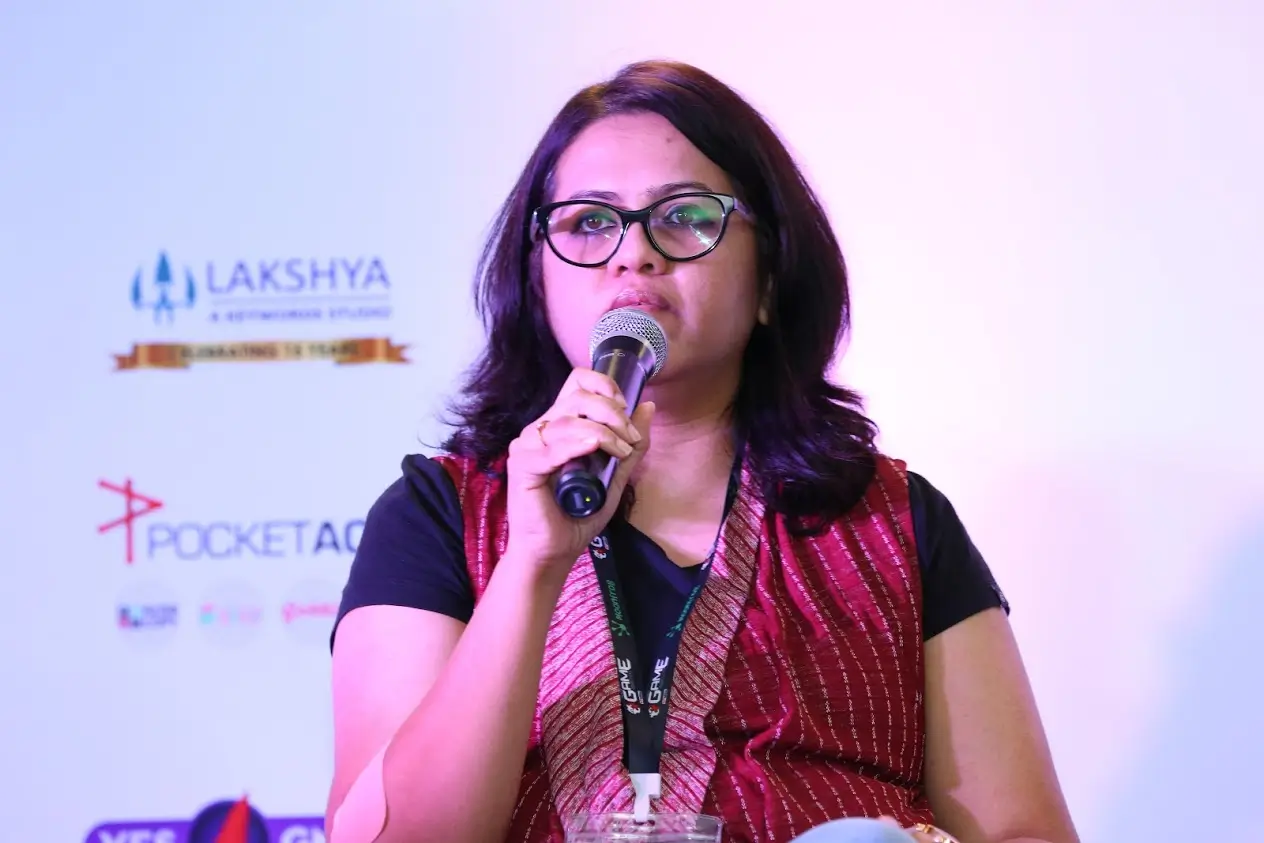
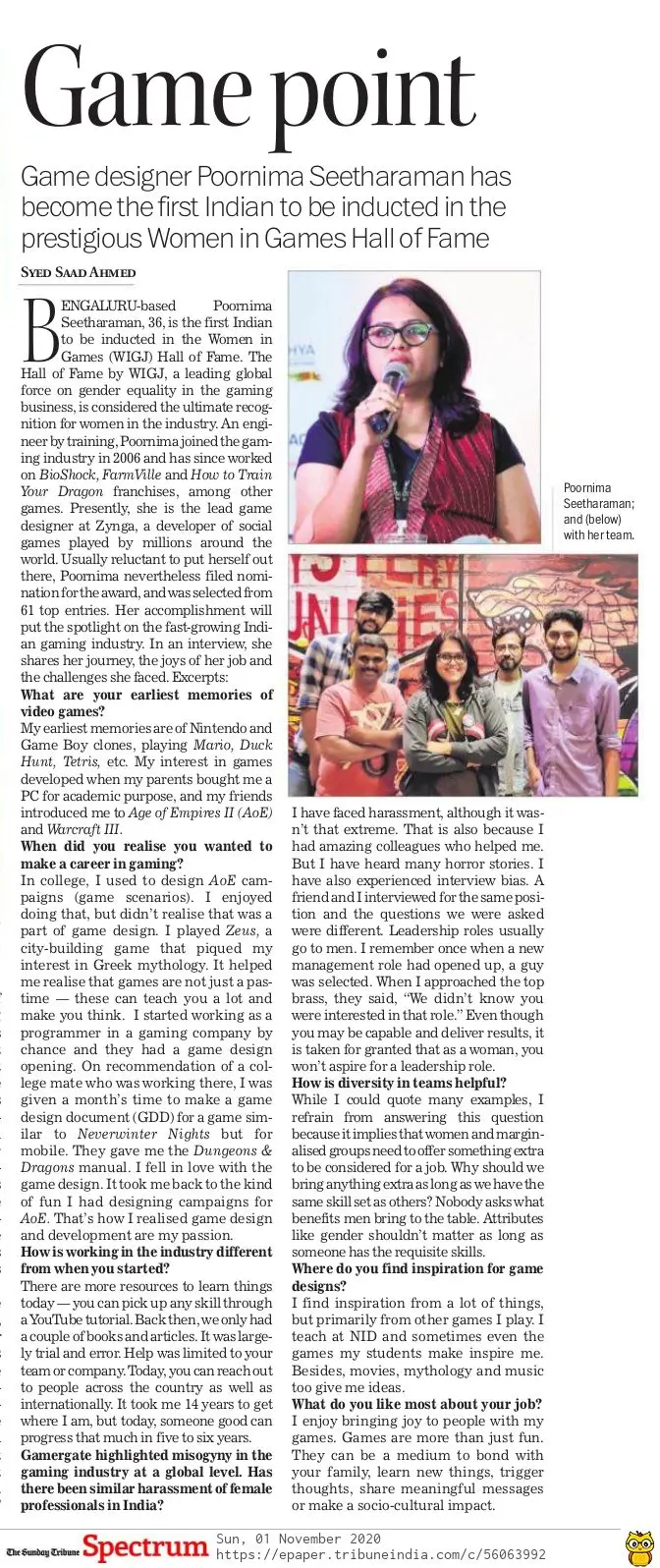
An edited version of this interview was published in The Tribune
Bangalore-based Poornima Seetharaman, 36, is the first Indian to be inducted in the Women in Games (WIGJ) Hall of Fame. WIGJ is a not-for-profit organisation promoting a games industry, culture and community free of gender discrimination. The Hall of Fame is considered the ultimate recognition for women in the industry.
An engineer by training, Poornima joined the gaming industry in 2006 and has since worked on BioShock, FarmVille and How to Train Your Dragon franchises, among other games. She is now the lead game designer at Zynga, a leading developer of social games played by millions around the world.
Usually reluctant to put herself out there, Poornima nevertheless filed her nomination for the award and was selected among 61 entries. Her accomplishment is likely to put the spotlight on the fast-growing Indian gaming industry. In a conversation over the phone, she shares her journey, the joys of her job and the challenges she faced.
What are your earliest memories of video games?
My earliest memories are of Nintendo and Game Boy clones, playing Mario, Duck Hunt and Tetris. My interest in games developed when my parents bought me a PC for academic reasons and my friends introduced me to Age of Empires II and Warcraft III.
You joined the gaming industry by chance. When did you realise you wanted to make a career in it?
In college, I used to design Age of Empires campaigns (game scenarios). I enjoyed doing that, but didn’t realise that was a part of game design. I played Zeus, a city-building game that piqued my interest in Greek mythology. It helped me realise that games are not just a pastime—they can teach you things and make you think.
I started working as a programmer in a gaming company by chance and they had a game design opening. One of my college mates was also working there. He referred me for that role. They gave me one month to make a game design document for a game similar to Neverwinter Nights, but for mobile. They gave me the Dungeons & Dragons manual. I remember going through it and falling in love with game design. It took me back to the kind of fun I had designing campaigns for Age of Empires. That’s how I realised game design and development are my passions.
How is working in the industry different now compared to when you started?
It’s much easier to grow now than before. There are more resources to learn things—you can pick up any skill through a YouTube tutorial. Back then, we only had a couple of books and articles. It was largely trial and error. Help was limited to your team or your company. Today, you can reach out to people across the country as well as internationally. It took me 14 years to get where I am, but today, someone good can progress that much in 5-6 years.
Where do you generally find inspiration for your game designs?
I find inspiration from a lot of things, but primarily from other games—I play a lot of games. I teach at the National Institute of Design and sometimes even the games that my students make inspire me. Apart from that, movies, mythology and music give me ideas.
What do you like most about your job?
I enjoy bringing joy to people with my games. Games are more than just fun. They could be a medium to bond with your family, learn new things, trigger thoughts, share meaningful messages or make a socio-cultural impact. It’s lovely to be able to do all these with games.
Gamergate (an online harassment and backlash campaign targeting women in the video game industry) highlighted the misogyny in the gaming industry at a global level. Has there been similar harassment of female professionals in India?
I have faced harassment, although it wasn’t that extreme. That is also because I had amazing colleagues who helped me. But I have heard many horror stories. I have also experienced interview bias. A friend and I interviewed for the same position and the questions we were asked were quite different. Besides, leadership roles usually go to men. I remember once when a new management role had opened up, a guy was selected. When I approached the top brass, they said, “We didn’t know you were interested in that role.” Even though you may be capable and deliver results, it is taken for granted that as a woman, you won’t aspire for a leadership role.
How is diversity in teams helpful?
While I could quote many examples, I refrain from answering this question because it implies that women and marginalised groups need to offer something extra to be considered for a job. Why should we bring anything extra as long as we have the same skill set as others? Nobody asks what benefits men bring to the table. Attributes like gender shouldn’t matter as long as someone has the requisite skills.


Leave a Reply