An edited version of this article was published in The New Indian Express.
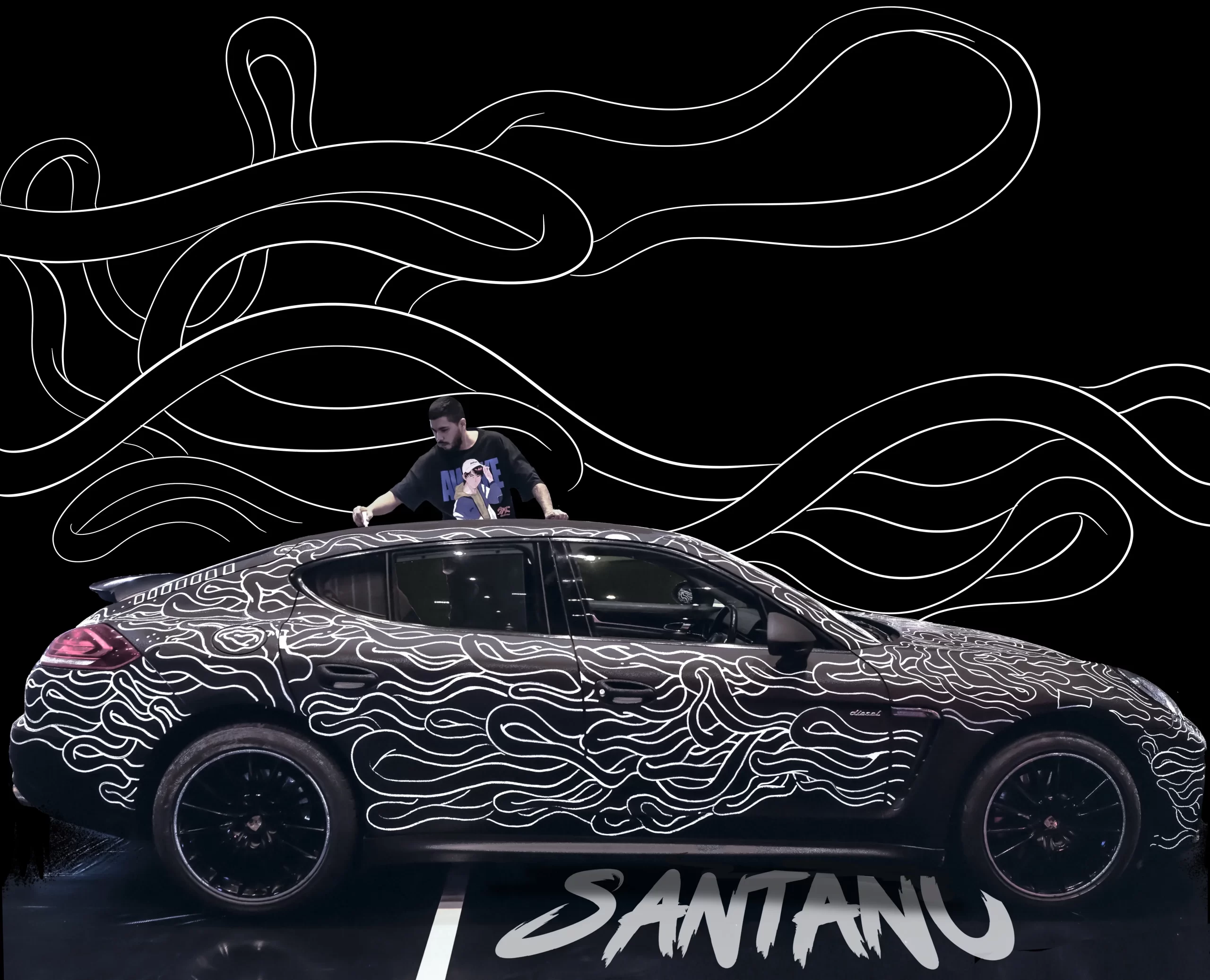
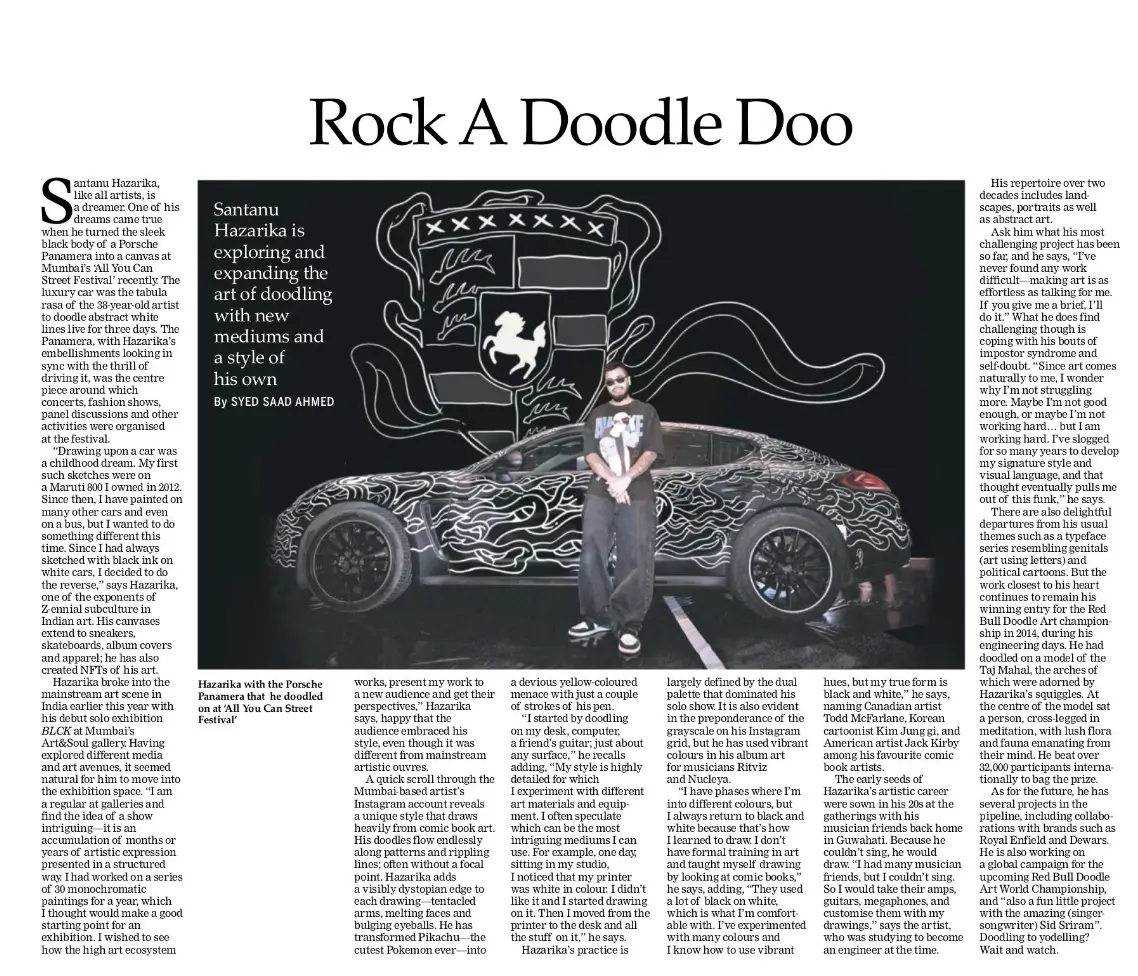
Santanu Hazarika’s latest artistic medium is a Porsche Panamera. He doodled on the car for three days at the All You Can Street Festival in Mumbai. “It was a live performance,” he says. “The Panamera was the centrepiece around which concerts, fashion shows, panel discussions and other activities were happening.”
“Drawing on a car was a childhood dream—it’s an iconic canvas. The first one I sketched on was my Maruti 800 in 2012. Since then, I have painted on many other cars and even a bus. But I wanted to do something different. I had always sketched black on white cars, so I decided to do the inverse: draw white on a black car.”
Apart from vehicles, Santanu’s art has materialised on canvas, sneakers, skateboards, album covers, apparel and as NFTs. “When I started doodling, I would do it on my desk, computer, a friend’s guitar, just about any surface,” he says. “My style is highly detailed and I experiment with art materials and equipment to execute that. I often think about the most intriguing medium I can draw on. For example, one day, sitting in my studio, I saw that my printer was all white. I didn’t like it that way, so I started drawing on it. Then I moved from the printer to the desk and all the stuff on it.”
He traces this habit to his lack of musical talent. “I had many musician friends in Guwahati, where I’m from, but I couldn’t sing,” he explains. “So I would take their guitars, megaphones, amps, etc. and customise them with my drawings. I guess that’s why I’m drawing on a supercar today.”
Santanu’s doodles seem to flow endlessly along patterns and rippling lines and often do not have a focal point. While he has used vibrant colours, such as in his album art for the musicians Ritviz and Nucleya, his Instagram grid has a preponderance of the grayscale.
Regarding this predilection, Santanu says, “I have phases where I’m into different colours, but I always return to black and white because that’s how I learned to draw. I don’t have formal training in art and taught myself by looking at comic books. They used a lot of black on white, so that’s what I’m comfortable with. I’ve experimented with diverse colours and I know how to use vibrant hues, but my true form lies in black and white.”
This colour palette also featured in his first solo exhibition, BLCK, held in February 2022 at art&soul, Mumbai. “After exploring different media and art avenues, it was natural to opt for an art exhibit. I am a regular at galleries and found the idea of a show intriguing—it is an accumulation of months or years of artistic expression presented in a structured way. I had worked on a series of 30 monochromatic paintings for a year, which I thought would make a good starting point for an exhibition. I wanted to see how the high art ecosystem works, present my work to a new audience and get their perspectives. Thankfully, people embraced my style, even though it’s different from what you usually see at galleries.”
When I ask him about his most challenging project, he says, “I’ve never found any work difficult—making art is as effortless as talking for me. If you give me a brief, I’ll do it.” What about his bouts of impostor syndrome and self-doubt, which he’s confessed to on Instagram? “Since art comes naturally to me, I sometimes feel like I’m not struggling enough,” he replies. “I think, why am I not facing more difficulties? Maybe I’m not good enough, maybe I haven’t explored much, maybe I’m not working hard… but I am working hard. I’ve slogged for so many years to develop my signature style and visual language. That thought eventually pulls me out of this funk.”
Indeed, Santanu’s work is quite prolific. There are also delightful departures from his usual themes, such as a typeface series resembling genitals and political cartoons. But the work closest to his heart is his winning entry for the Red Bull Doodle Art championship in 2014. He had doodled on a model of the Taj Mahal, his squiggles adorning its many arches. In the centre is a person seated cross-legged in meditation, with lush flora and fauna seemingly emanating from his mind. “I was miserable doing engineering then and failing in all subjects, so that doodle became the turning point in my life,” he says. “Thanks to doodling, I learned to design, sketch and draw and reached where I am now.”
Leave a Reply